Algorithms + Heuristics – A Hybrid Approach to Problem-Solving
1. Introduction – Two Paths to Solving Problems
In design and product leadership, not every problem can be solved by logic alone—and not every decision can rely on gut instinct. We are often caught between the allure of data-driven certainty and the wisdom of experienced-based intuition. This tension lies at the heart of effective problem-solving.
To navigate it, we must understand two fundamental modes of thinking:
- Algorithms: Structured, step-by-step, often quantitative processes guaranteed to produce a correct result. In business, this translates to A/B testing frameworks, detailed user research analysis, and strict compliance workflows.
- Heuristics: Rule-of-thumb, experience-driven shortcuts that are fast but not foolproof. This is the "gut feeling" about a user's pain point or the creative leap that bypasses endless analysis.
Relying exclusively on one is a trap. The most effective leaders and designers don't choose a side; they master the balance. A hybrid model that blends algorithmic rigor with heuristic insight is the key to tackling the complex, ambiguous challenges of modern product development.
2. Why Relying on One Approach Fails
An exclusively algorithmic approach risks over-engineering. It can be slow, rigid, and ill-suited for ambiguous, novel situations. While perfect for optimizing a known checkout flow, it can paralyze a team exploring a brand-new market.
Conversely, a purely heuristic approach is fast but risky. It can introduce cognitive biases, leading to decisions that feel right but are misaligned with user needs or business goals. Imagine a UX team debating feature priority: the data (algorithm) might point to one option, but deep user empathy (a heuristic) reveals a critical, unquantifiable nuance. Choosing only one view leads to an inferior outcome.
3. The Hybrid Approach in Action
The magic happens in the interplay. We can break this down into practical principles:
- Frame with Algorithms, Decide with Heuristics: Use structured analysis to narrow the field, then apply judgment for the final leap. Before a design sprint, use quantitative surveys and competitive analysis (algorithms) to define the problem space. Then, use team intuition (heuristics) to select the most promising idea to prototype.
- Prototype Fast (Heuristic), Validate with Data (Algorithm): A designer’s creation of a near-final prototype is a heuristic act—an educated guess. Its success, however, is validated algorithmically through usability metrics and A/B tests.
- Heuristics for Exploration, Algorithms for Scaling: Explore new possibilities intuitively, but codify successful solutions when rolling out at scale. A heuristic-based insight that a specific button style improves engagement can be algorithmically codified into a company-wide design system.
Anecdotes from the field:
- At Intuit, we conducted 700+ customer interviews (algorithmic rigor) to understand pain points. But synthesizing that data into a coherent roadmap required heuristic trade-offs based on strategic vision.
- At PayPal, heuristic-driven prototypes aimed at improving "motion clarity" were later validated by a significant jump in user task-completion metrics (algorithmic proof).
- At Amazon, reinforcement learning (a powerful algorithm) optimizes workflows, but it was paired with heuristic UX tweaks from designers who understood human frustration, leading to greater efficiency gains than either method alone.
4. Lessons from Psychology
This hybrid model is rooted in how our minds actually work. Nobel laureate Herbert Simon’s concept of bounded rationality posits that humans rarely make purely logical decisions due to cognitive limits. We satisfice—use a mix of logic and shortcuts.
Daniel Kahneman’s model of System 1 (fast, intuitive, heuristic) and System 2 (slow, deliberate, algorithmic) thinking shows that effective problem-solving is a dance between the two. Great designers have the self-awareness to know when they are in exploratory, heuristic mode versus execution-oriented, algorithmic mode.
5. A Framework for Hybrid Problem-Solving
Leaders can institutionalize this balance with a simple, four-step model:
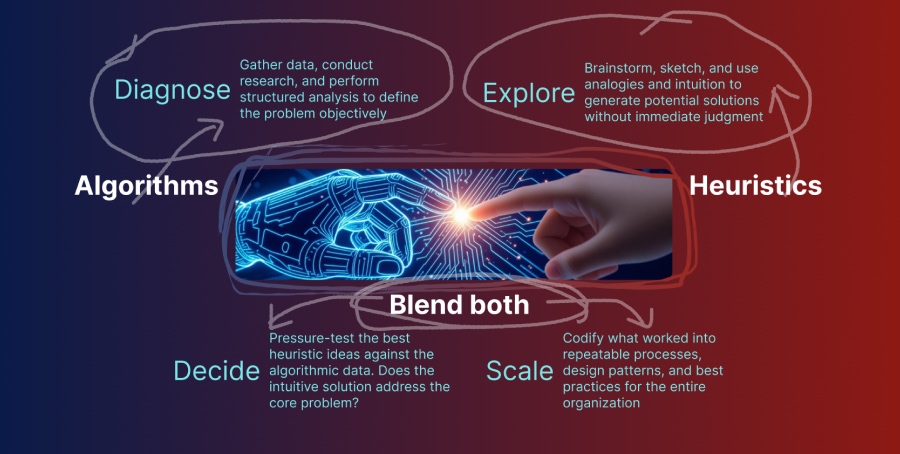
- Diagnose: Use algorithms. Gather data, conduct research, and perform structured analysis to define the problem objectively.
- Explore: Apply heuristics. Brainstorm, sketch, and use analogies and intuition to generate potential solutions without immediate judgment.
- Decide: Blend both. Pressure-test your best heuristic ideas against the algorithmic data. Does your intuitive solution address the core problem identified in Step 1?
- Scale: Alchemize heuristics into algorithms. Codify what worked into repeatable processes, design patterns, and best practices for the entire organization.
This forms a continuous loop: algorithms inform heuristics, which then inspire new, more refined algorithms.
6. The Leadership Lens
Ultimately, this is a leadership imperative. UX and Product leaders must train their teams to know when to lean on data and when to trust intuition. We must foster a culture where heuristics are seen as hypotheses to be tested, not dismissed, and algorithms are guides, not cages. As I often say, "Heuristics start the journey, algorithms finish it."
7. Conclusion – Designing with Two Hands
The future of problem-solving is not a choice between intuition and logic but a synergy. Algorithms give us the confidence of certainty, ensuring our decisions are grounded and scalable. Heuristics give us the spark of possibility, allowing for creativity and adaptation in the face of ambiguity.