Why UX Must Be Measured in Product Outcomes
1. Introduction – The Shift from Outputs to Outcomes
At Intuit, we once redesigned a QuickBooks onboarding flow to be radically simpler. The internal feedback was glowing—the design was intuitive, the usability scores were high. But the project wasn't a success until we saw the metrics that mattered: a significant lift in completed onboarding and a reduction in support tickets. This was a pivotal lesson. UX has long been judged by its outputs—wireframes, prototypes, and usability scores. While valuable, this keeps the design function siloed, perceived as a service rather than a strategic driver. The paradigm must shift. UX must be evaluated not by its deliverables, but by its impact on tangible product outcomes like adoption, retention, and revenue.
2. Why Traditional UX Metrics Fall Short
Metrics like System Usability Scale (SUS) scores, task completion rates, and Net Promoter Score (NPS) are useful diagnostic tools. They tell us if an interface is easy to use, but they don’t tell us if it’s valuable. It’s entirely possible to create a frictionless interface for a feature that users simply don’t need or want, resulting in no change in adoption or subscription renewals.
This is the fundamental risk: when design is measured solely on usability, it risks becoming a form of decoration—polishing a product without ensuring it solves a core business problem. A beautiful, seamless flow that doesn’t move the needle on key performance indicators (KPIs) is, in the end, a strategic miss.
3. What Product Outcomes Look Like for UX
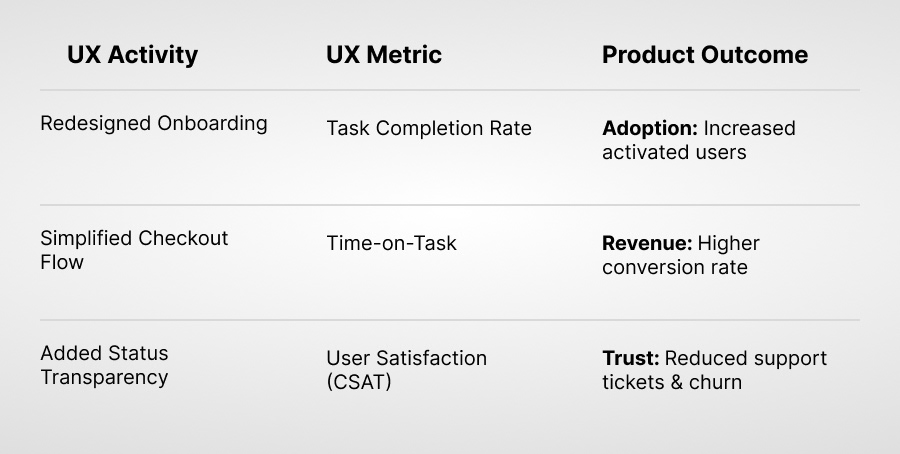
For UX to claim its strategic role, its work must be explicitly tied to the KPIs the business cares about. This means mapping design activities to outcomes across the product lifecycle:
- Adoption: A successful first-time user experience (like the QuickBooks onboarding flow) directly impacts sign-up and activation rates.
- Engagement: Intuitive navigation and discoverable features drive frequency of use and depth of engagement.
- Efficiency: Streamlined workflows, such as those in Amazon's internal tools, reduce task completion time and operational costs.
- Retention & Trust: A reliable and transparent experience, like a clear dispute resolution process in PayPal, builds user confidence, reduces churn, and fosters long-term loyalty.
- Business Impact: At Cisco, investing in a unified design system wasn’t about aesthetics; it was about the outcome of accelerated product velocity and reduced development costs.
4. Bridging UX and Product Strategy
This outcome-oriented mindset requires deep collaboration. UX research cannot exist in a vacuum. The insights from the 700+ customer interviews we conducted at Intuit weren’t just reported; they were directly translated into the product roadmap, informing the development of features that addressed real SMB pain points. This is co-ownership. The design process shouldn’t end at a usable prototype; it should end when a business goal is achieved. As the saying goes, “Good UX feels seamless. Great UX moves the business forward.”
5. Frameworks for Measuring UX in Product Outcomes
To make this practical, teams can adopt established frameworks that connect user experience to business results:
- HEART Framework (Google): This model shifts focus from isolated usability to metrics of Happiness, Engagement, Adoption, Retention, and Task success.
- North Star Metric (NSM): Identify the single metric that best captures the core value your product delivers. For a platform like QuickBooks, this could be “the number of active SMB accounts.” Every UX initiative should be evaluated against its impact on this North Star.
- Balanced Metrics Approach: Combine quantitative data (adoption rates, efficiency gains) with qualitative insights (user trust, perceived value) for a complete picture.
A simple mapping exercise can clarify this connection for any project:
6. Case Snapshots
- QuickBooks Enterprise: The extensive user research (700+ interviews) directly informed five new features, which led to a measurable boost in adoption among small businesses.
- PayPal Dispute Resolution: By using motion design to create clarity and transparency in the dispute flow, we improved merchants' perception of fairness—an outcome reflected in a +2% lift in positive app store reviews.
- Cisco Design Systems: The investment in unified components was justified by the product outcome of faster time-to-market and measurable engineering efficiency gains.
7. The Leadership Perspective
For executives, this is the language of business. A UX leader’s role is to coach their team to speak this language—to articulate how a design decision will impact the P&L through increased efficiency, higher retention, or new market adoption. The value of UX is in reducing the uncertainty of product investments by ensuring we build the right thing, in the right way, for the right users.
8. Conclusion – The Future of UX Measurement
The evolution of UX from a service function to a strategic partner hinges on this shift in measurement. When we tie our work to product outcomes, we move beyond arguing about pixels and begin demonstrating our contribution to growth. This is how design earns its seat at the strategy table and secures its influence. When UX is measured in outcomes, design stops being optional—it becomes indispensable to product success.